
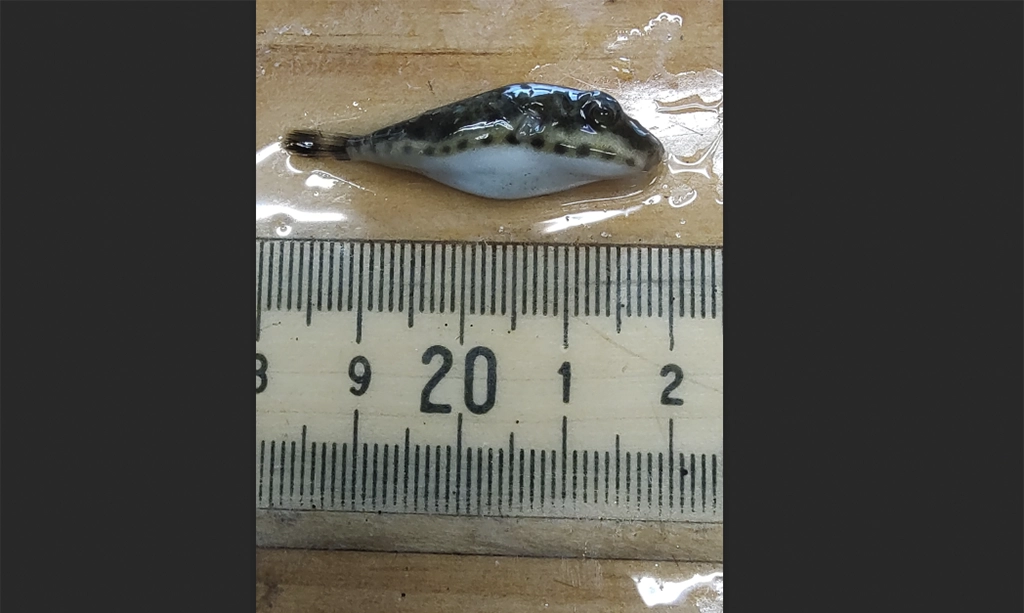
Long-term collections of planktonic fish larval and settled juveniles are important for the detection of trends that are too subtle to be seen in short-term experiments. Last week, we collected a juvenile Bandtail Puffer (Sphoeroides spengleri) in traps sampled twice-weekly over the last 34 years. Over the entire series, we have only seen this species 6 times previously, 5 of those all together in 2015.
This catch is a fatal tropical expatriation – fish spawned by adults to the south, including Florida, the Caribbean, and Sargasso Sea, that are delivered to New Jersey as drifters in offshoots of the Gulf Stream. Many such species are reef fish that will settle here, but unlike their powerful swimming open water cousin, they cannot emigrate when winter comes will die. Even locally spawned fish, like the abundant Northern Puffer (aka blowfish) and Atlantic croaker, can experience mass winter mortality in some years, and this resets the expnding northern edge of their range. Likewise, the southern edge of the range for northern species, like Winter Flounder (Pseudopleuronectes americanus) is set by temperature, but by being too hot to handle in their case.
Life other puffers, the Bandtail Puffer can inflate itself with water to make itself harder to eat. It is highly toxic if consumed. These life history investments are important for a species that looks like a tasty crouton and swims only a little better than one.