
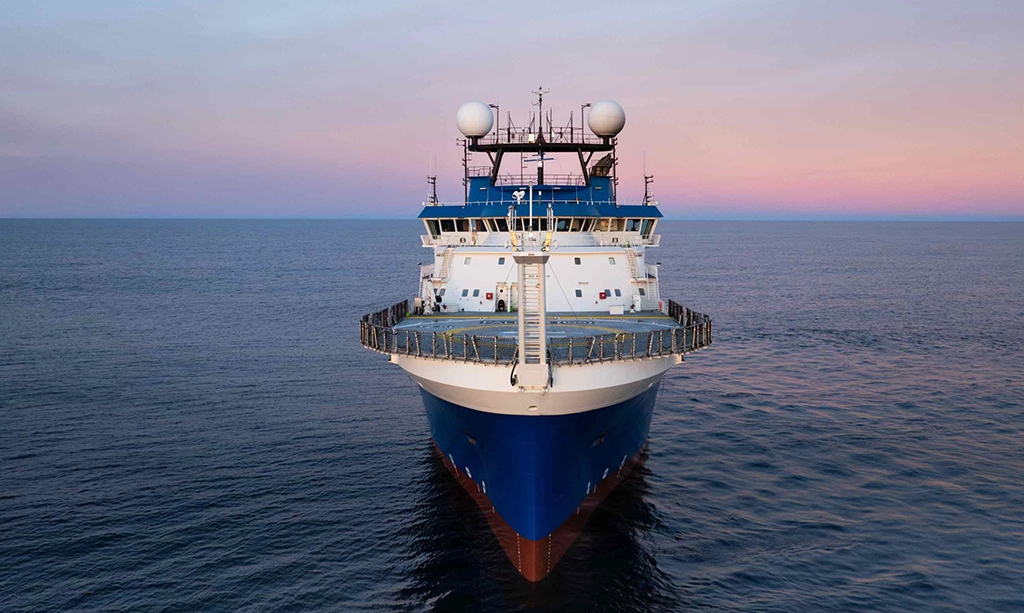
Rutgers researchers will study small ocean processes with big consequences
At sea, their days will begin in darkness.
Before dawn, Rutgers oceanographers Joe Gradone and Corday Selden expect to be on deck aboard the research vessel Falkor (too), preparing instruments, reviewing data and directing the first collection of water samples of the day.
Related: Read more about the scientists leading the mission
Gradone and Selden will serve as co-chief scientists on a 25-day expedition in the Atlantic Ocean supported by Schmidt Ocean Institute. Departing from Bridgetown, Barbados, on Aug. 9, the international research team will study salt finger mixing, a subtle form of ocean mixing that may influence marine life, ocean chemistry and the movement of carbon through the sea.
The work will require a demanding shipboard rhythm.
Gradone and Selden expect to be on deck by about 3 a.m. as the ship approaches the first major sampling location of the day. Before dawn, the team will prepare instruments, lower equipment into the ocean and begin collecting information from below the surface.
At full sampling stations, a carousel of bottles will descend through the water. As measurements appear on a screen, Selden and other scientists will decide the depths at which those bottles should close.
When the device returns, teams will divide the water for experiments measuring photosynthesis, nutrients and the condition of microscopic marine organisms. Other researchers will collect zooplankton, tiny organisms that graze on marine plants.
After breakfast, the sequence will begin again. A third major station will follow in the afternoon. Smaller teams will continue taking measurements through the night.
Most days will preserve this rhythm. During two especially demanding 48-hour studies, the ship will remain in place while scientists conduct large experiments involving many bottles, extensive water sampling and repeated net tows.
“It’s a big lift,” said Selden, who meant that literally as well as scientifically.
The demanding schedule is designed to help the team capture changes in the ocean that cannot be detected from the surface.
Full article at Rutgers Today