
What are we finding?
Hidden Comet-Tails of Marine Snow Impede Ocean-based Carbon Sequestration’
The downward flux and biological pumping of carbon into the ocean interior in the form of marine snow directly regulates our climate and is a critical component for carbon sequestration. The multi- scale nature, biological complexity and lack of direct observations of marine snow particles and their sedimentation has fundamentally limited mechanistic understanding of this downward flux and this has hampered uncertainty in carbon flux predictions. Using a newly invented scale-free vertical tracking microscopy, researchers from Stanford, Rutgers and the Woods Hole Oceanographic Institution measured for the first time, the microscopic sedimentation and detailed fluid-structure dynamics of marine snow aggregates in field settings. Their microscopically resolved, in-situ particle image velocimetry (PIV) measurements of a large number of field-collected marine snow aggregates revealed a ‘comet tail-like’ flow morphology that was universal across a range of hydrodynamic fingerprints. Using this dataset, the researchers calculated how ‘viscoelastic distortions’ of mucus impact the sinking speeds and tail lengths of marine snow dressed in mucus. The presence of mucus-tails doubled the mean residence time of marine snow in the upper ocean, reducing overall carbon sequestration due to microbial remineralization. These findings set forth a theoretical framework within which to understand marine snow sinking flux and pave a novel way forward towards a predictive understanding of this transport phenomena in the open ocean.
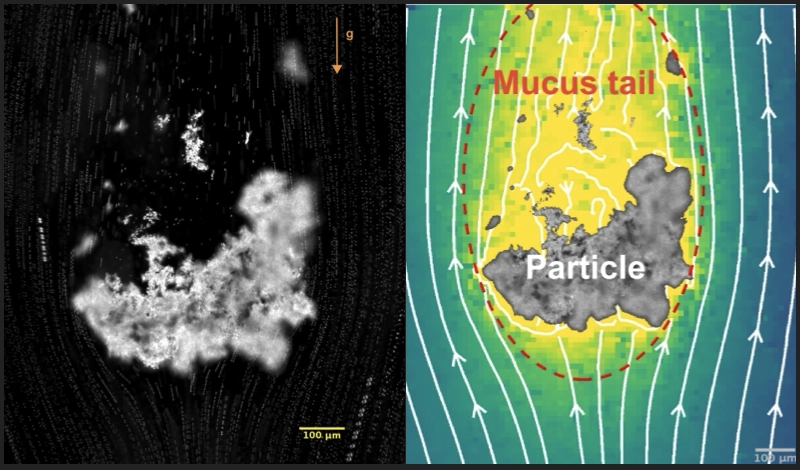
Microscale measurements of the flow field around sinking marine snow particles reveals an approximately ellipsoidal mucus halo (comet) enclosing the visible particulate aggregate. These mucous comments have lower density and can act as parachutes that impede sinking speeds of the aggregates.
This research was a critical part of a NSF-funded Growing Convergence Research (GCR) project led by Rutgers’ Kay Bidle (Department of Marine and Coastal Sciences), which brings together biologists/chemists/physicists/engineers/applied mathematicians/modelers from Rutgers University-New Brunswick, the Woods Hole Oceanographic Institution, Stanford University, the University of New Hampshire, the National Center for Atmospheric Research (NCAR) and the National Aeronautics and Space Agency (NASA) to understand the coalescence of marine viruses, biominerals, microscale physics and ecosystem interactions on phytoplankton carbon sequestration.
The GCR program represents the National Science Foundation’s Ten Big Ideas (https://www.nsf.gov/news/special_reports/big_ideas/)with an emphasis of the need for the sciences to practice such an integrated, transdisciplinary approach to science to solve a variety of challenges facing our planet and humanity.

Analysis of a ‘zoo’ of particles from the Northwest Atlantic ocean revealed that the mucous tails were universal across a range of hydrodynamic fingerprints. They had escaped previous detection until visualized and analyzed with a novel gravity machine. The presence of the mucous tails fundamentally changes how we view particles and carbon flow in the oceans
The Rutgers-led GCR group has already made some key discoveries, which have positioned them to solve this challenge. These include developing specific biomarkers to diagnose infection of phytoplankton at sea; documenting that actively infected phytoplankton cells clump together and sink into the deep ocean across the Atlantic Ocean; quantifying the amount of carbon fluxing from infected cells in sunlight surface waters to the deep ocean; characterizing the relationship of seasonal ocean mixing regimes with the extent of virus infection; and engineering a new way to track and characterize the vertical movement and biophysical properties of individual sinking particles on a hydrodynamic treadmill.
Critical discoveries are still to come including the role that ocean turbulence (via storms) plays in driving the extent of infection and the relative balance between the formation (aggregation) and destruction (disaggregation) of sinking particles as they transit to depth; the role that virus infection plays in coupling particle production with other ecosystem pathways; and developing the capability to predict the conditions under which virus-induced carbon export is maximal across the oceans.